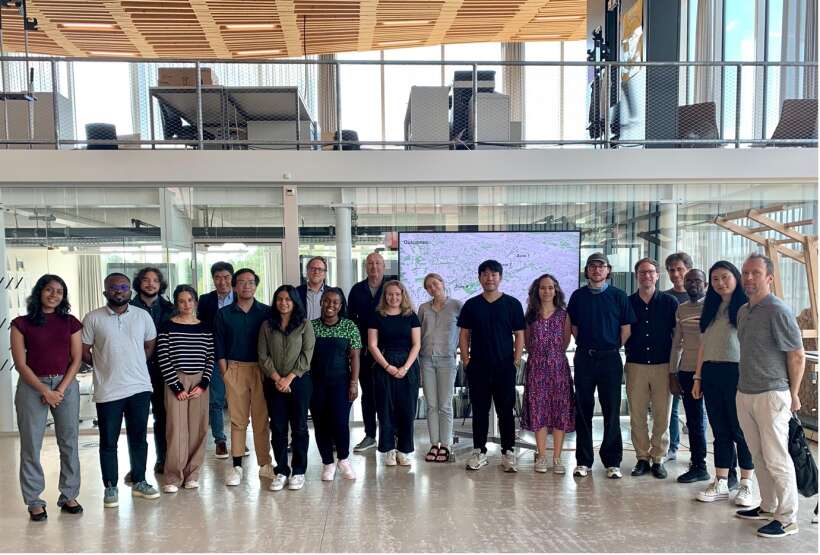
Our second Summer School, Dense and Green Cities: Exploring New Models of Integrated Urban Development FS2024, was concluded with plenty of fun and plausible outcomes at PBLab, ETH Zentrum, on Friday the 19th of July.
Similar to the first edition, the summer school aimed to explore the complexity of urbanisation and take an interdisciplinary approach to urban design through various activities, including a city tour, input lectures, teamwork and seminar discussions. Unlike the previous year, the program provided three urban design and analytical tools: ArcGIS Urban, City Energy Analyst (CEA), and Microclimate Digital Platform (MDP), in addition to introducing fundamental principles and the latest research outcomes, which enabled the participants to compare outcomes of various densification scenarios in terms of 2D and 3D views, energy demands and renewable energy yields, and microclimate, and optimise urban design strategies. In the last two days of the program, participants re-evaluated their urban design regarding governance instruments, planning approaches, and social inclusion and justice. Creative thoughts and ideas even went beyond the context of Zurich by reflecting on the implications in various cultural backgrounds.
This year, our summer school was enriched by the global participation of not only bachelor, master, and doctoral students from ETH Zurich but also international students from Denmark, Ghana, India, Italy, the Philippines, and Thailand. This diverse mix of backgrounds, disciplines, and cultures added a unique dimension to the summer school. It was a challenging, intensive, but exciting journey for everyone, working together, learning from each other, and completing the task within a minimal time. From the ice-breaking workshop on the first day to the reflection discussion at the end, the impact of this global participation was evident in everyday work and conversations and, moreover, sparked spontaneous ideas for research collaborations beyond the summer school.
We extend our heartfelt thanks to our lecturers, Prof. Dr Yuan Chao from the National University of Singapore and Dr Zhongming Shi from the Chair of Architecture and Building Systems. Their invaluable knowledge sharing on urban heat islands, microclimate, and urban energy analysis greatly enriched the learning experience. We are also deeply grateful for the support from LVML Computer Lab, PBLabs, and SAM Architekten, whose dedication and resources made our summer school a resounding success.