Recent News
Articles, updates and posts from Future Cities Laboratory Global and its various projects and modules
Articles, updates and posts from Future Cities Laboratory Global and its various projects and modules
Our proposed approach is, focusing on a topical coupling towards an integration of both evidence-based design and design-based evidence principles. Similar to Design and Science, the concept of Semantic Urban Elements is a process and the outcome of that process.
Clustering of urban functions can foster spatial interactions. We aim to develop a quantitative theory of urban design and study places of social gathering in Singapore and Zürich and derive the key planning and design attributes.
Cognitive science research methods, including behavioural experiments, psychophysiological measurements, eye-tracking and agent modelling, can provide valuable insights. They can inform designers in planning urban and architectural interventions to enhance the wellbeing and comfort of urban populations.
Our module aims to design landscapes for resilient and sustainable cities harnessing the potential of blue-green infrastructures. We use point-cloud models for the precise documentation of critical infrastructures like the complex irrigation and drainage systems of Antananarivo.
Drawing from case-study regions in Asia and Europe and specific sites within the Zurich region, the project aims at better understanding processes of extended urbanisation in agricultural territories.
We are investigating the various types of AGURA that are emerging in Monsoon Asia, where they are concentrated. We consider the potential of these areas to address the overarching challenges of urbanisation and agricultural intensification. We adopt the term ‘agropolitan’ to signal the ideal mix of conditions that would serve that goal.
The Sea-City Interface project focuses on mitigating climate impacts at the sea-city fringes in rapidly urbanising cities in tropical Asia.
CEC investigates relationships between urban patterns and urban functions in the domains of biodiversity, climate & energy, hydrology, socio-economics, and public health across cities.
The Adaptive Mobility, Infrastructure and Land-use module [AMIL], started in January 2023, envisions to improve infrastructure planning processes to better and faster meet the needs of stakeholders (e.g., carbon neutrality, 45-Minute City by 2050).
In nature, mycelium fosters organic matter decomposition and mushroom growth. In technology, it serves as an eco-friendly bio-binder for low-embodied-energy bio-composites. Its dual role as a binder and degrader in mycelium-bound composites (MBC) may enable a sustainable, resource-borrowing approach to circular construction.
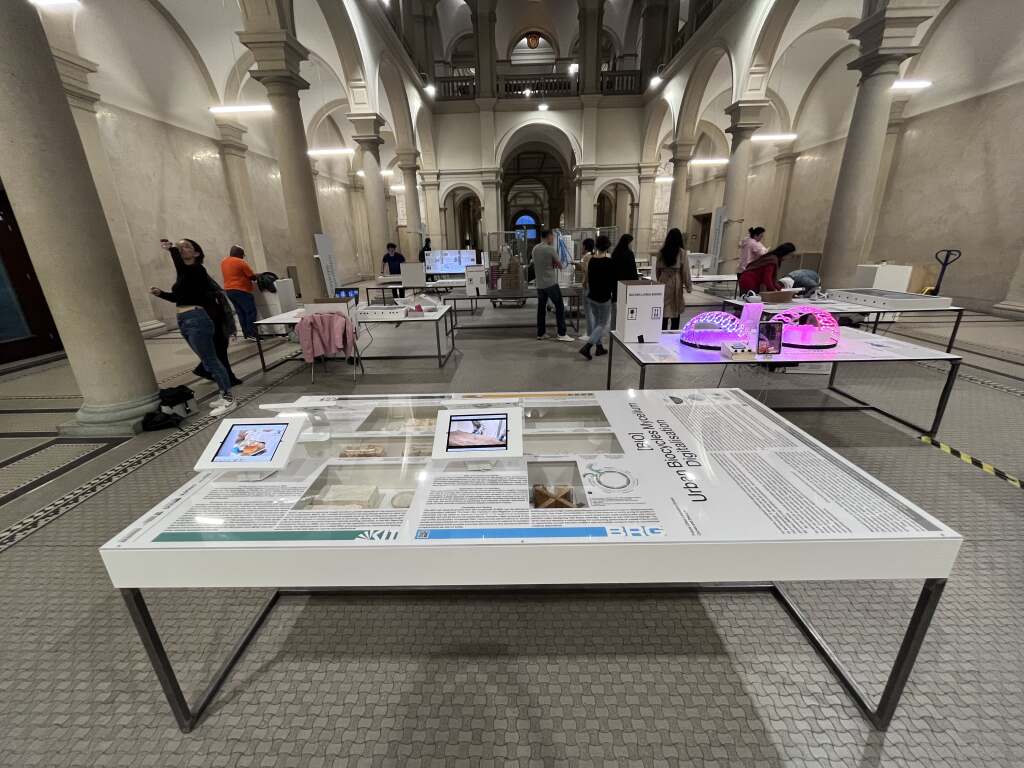
Interdisciplinary research activities of the POW module spanning expertise from engineering to social sciences, from physics to economics, from Zurich to Singapore, for now and the future. The four major themes “Life Cycle”, “Energy Design”, “Mobility”, and “Socioeconomics” are respectively introduced on this exhibition stand.